24 Sep 2026
Another step closer to net zero - highlights from our latest climate report

Since building some of the UK’s first wind turbines in the late ‘90s’ Thrive has built and funded over 48 clean energy projects, playing a significant part in the UK’s net zero transition. To date, these projects have saved over 1.1 million tonnes of carbon emissions over the life of the business.
Delivering on our mission – putting money to work building new clean energy projects and empowering people to take action to address the climate emergency – means that our positive contribution to avoiding UK carbon emissions far outweighs our own carbon footprint. However it is important to report on and reduce carbon emissions that are made in construction and operations.
Thrive’s latest climate report shows another year of good progress on our path to reaching net zero emissions by 2030. Let’s dive into some of the highlights…
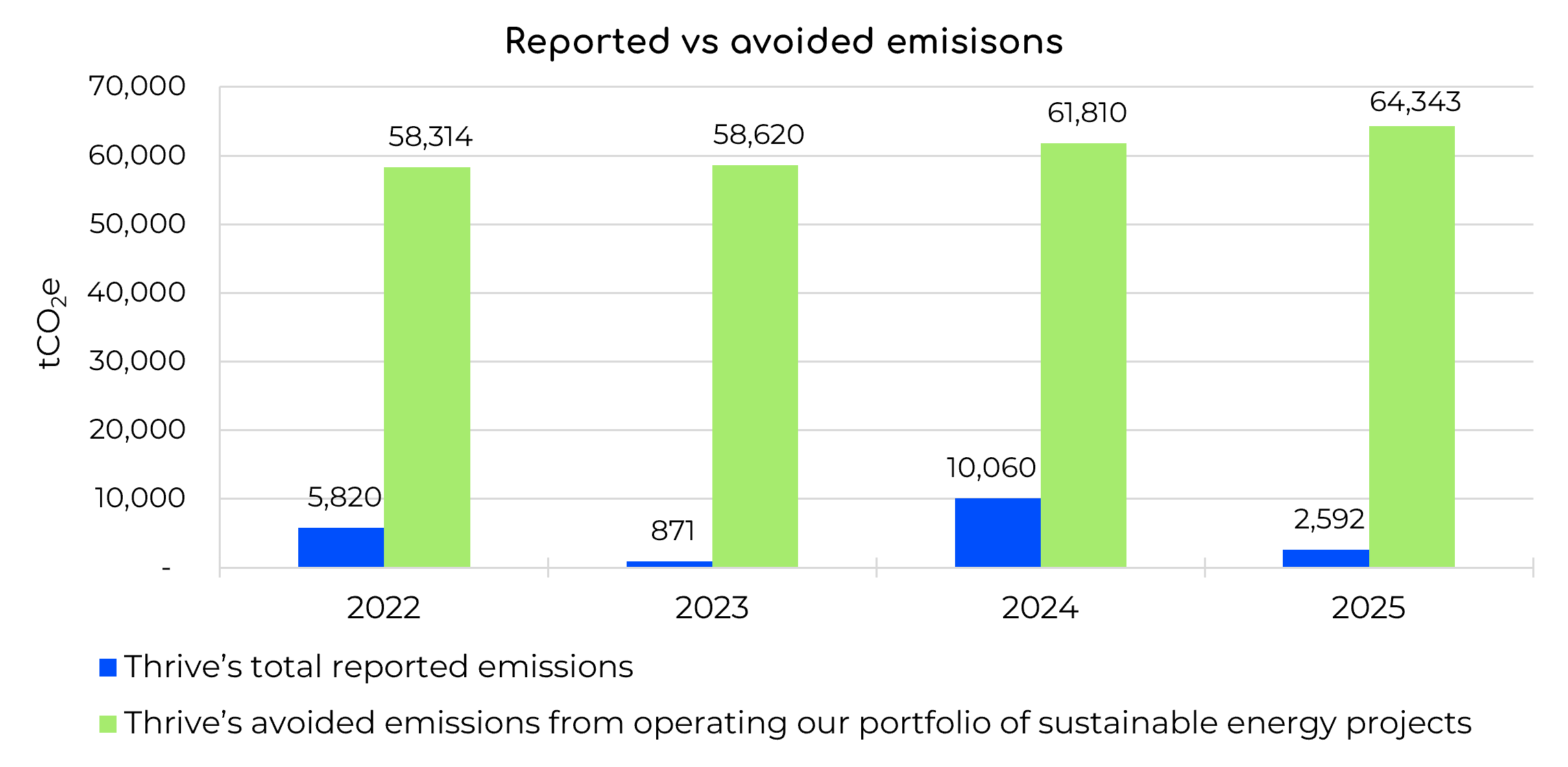
Emission reductions are the emissions ‘avoided’ from the operation of our portfolio of clean energy projects (also referred to as scope 4). 2022 and 2024 were both very successful years for project construction and in both years our reported emissions include the construction footprint of three new projects.
We are pleased to have achieved full scope 3 reporting for a fourth year, with the carbon intensity of our day-to-day services decreasing by around 14% when comparing 2025 to the base year 2022. This is encouraging to see and is supported by the decarbonisation stories we have heard through our supplier engagement – see below.
Our annual contractor engagement continues to encourage positive discussions on how to reduce emissions in our industry. In 2025, one asset manager cut travel emissions 66% by adopting EVs for 81% of their travel to Thrive’s sites, compared with 100% diesel fleet in 2024. Whilst requiring further planning to journeys to ensure the charges are kept in range, they managed to implement a significant step in the decarbonisation journey.
It is also positive to see that the emissions intensity of the electricity imported to BESS (Battery Energy Storage System) projects has dropped by 38% from 2022 to 2025, putting us on track for this target area.
Trains continue to comprise the majority of our business miles travelled in 2025, with the carbon intensity of our average business mile now 40% lower than when we first started reporting on this in 2019.
Although not directly relevant to Thrive’s own reported emissions, we encourage our employees to reduce their own personal greenhouse gas footprints as well. For example, Thrive offers the ‘Sustainable Travel Leave’ benefit which rewards staff with paid journey days when opting for slower, greener options for their holiday travel.
We are also currently looking to implement low carbon materials, such as using green steel, on new projects in our pipeline.
Latest news
24 Sep 2026
Another step closer to net zero - highlights from our latest climate report
Read more
18 Sep 2026
Don’t believe the hype – how to debunk the recent misinformation around renewables
Read more
17 Sep 2026
Half year results 2026 – locking in impact for the next 30 years
Read more